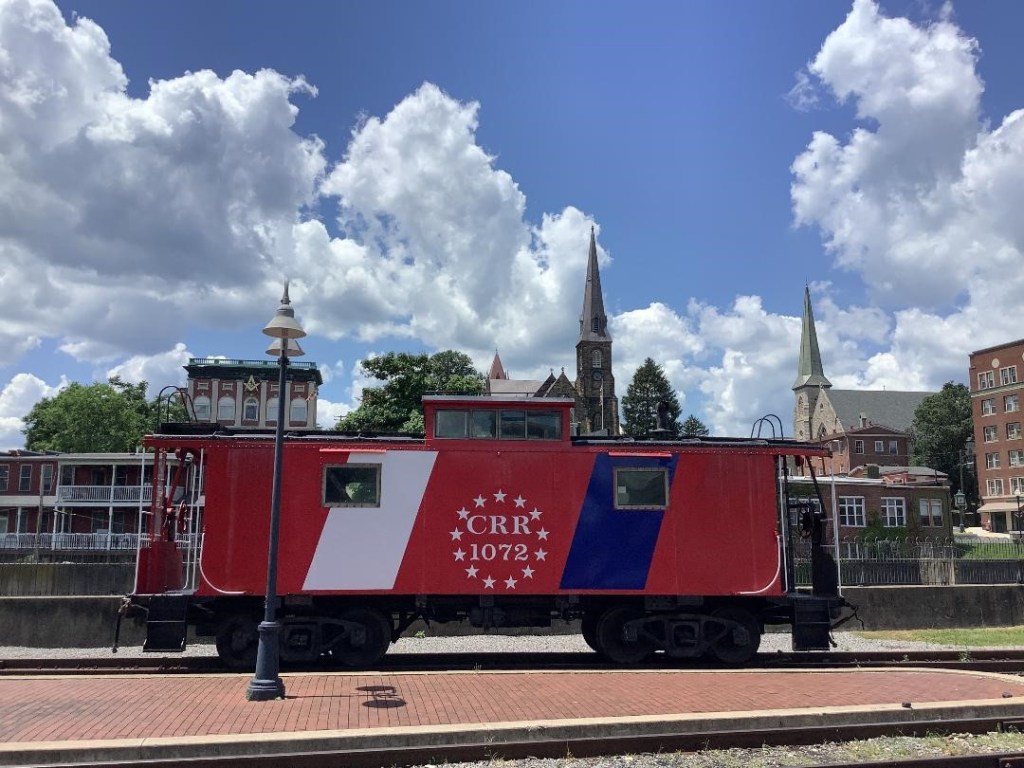
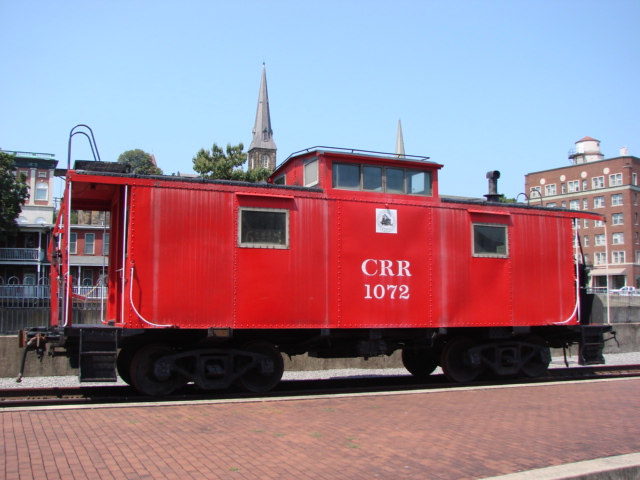
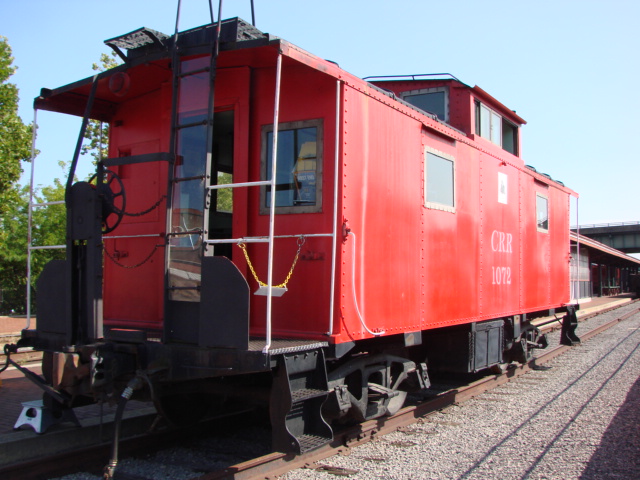
Welcome aboard the CRR 1072 caboose. This particular caboose was built in July 1948 for the Clinchfield Railroad. It is now owned by the Western Maryland Chapter of the National Rail-way Historical Society (NRHS). We re-painted the exterior back to the original bright red color with white lettering as can be seen in the framed photograph attached to the wall above the bench seat. But the interior of the caboose was left almost exactly as it was when CSX Transportation kindly donated this railcar to the Western Maryland Chapter NRHS in 1990. However in July 2023 to celebrate the 75th anniversary of this caboose, the interior was re-painted back to its original color with Sherwin-Williams Reclining Green (SW 6744). So one can see that the caboose is not a fancy railcar – it is a work place for the freight train conductor and rear brakeman. The ca-boose has just a few basic conveniences for the crew, such as the table with two bench seats around it, the diesel-fueled stove to heat the caboose in cold weather or to cook food, and within the aluminum enclosure at the far end of the caboose is the latrine.
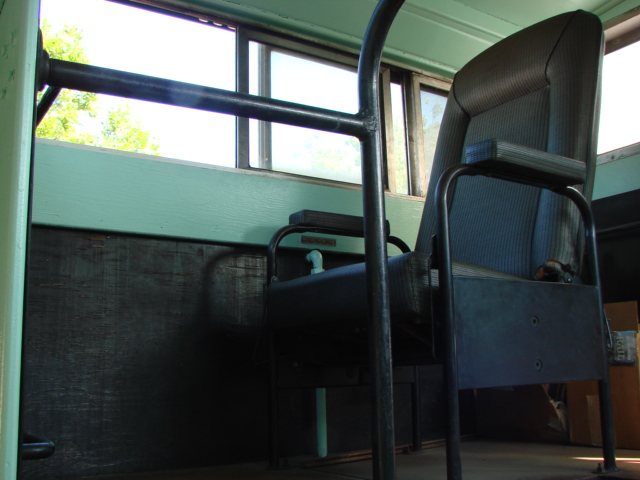
The working part of the caboose is the raised central section with all the windows around it, which is called the cupola (KOO-pa-la – it is an architectural term meaning “little cup” or “little dome.”) Anytime the train is moving, at least one of the crewmen had to be sitting in the seats in the cupola watching from the rear of the train for anything that might be a hazard to the safe operation of the train. They would be looking for such things as overheated wheel bearings, shif-ting cargo on the flatcars or log cars, or unauthorized personnel boarding the train such as hobos. From time to time, they would look at the gage above the passageway near the “B” end of the ca-boose. That gage measures the air pressure in the braking system throughout the entire length of the train. When the train is moving, the gage’s needle should be pointing between 80 to 90 pounds per square inch of air pressure in order to keep the brake shoes away from the wheels, so they are not wearing out prematurely. If the crewmen find a problem, they can get on the radio-telephone above the passageway near the “A” end of the caboose, and talk to the locomotive engineer at the other end of the train, or to the train dispatcher a couple hundred miles away, and explain what the problem is. However in an emergency, anyone sitting in either of the seats in the cupola can stop the entire freight train if necessary. Underneath the armrest next to the out-side wall is an air valve with a red handle. All that needs to be done is turn that handle just a quarter of a turn, which then opens the air valve, then a hissing sound is heard outside as the air escapes under pressure, the needle on the air pressure gage drops to zero, and every brake on every car in the train will be engaged against its wheel. Hopefully, that action will bring the freight to a safe stop, but it may take up to a mile to bring the train to a complete halt, depending on the speed of the train and the steepness of the track. Trains do not stop on a dime – they’ll roll right over that coin, and it is very flat when all is finished!
More crew conveniences can be seen in the final section of the caboose. A stainless steel ice box is attached to the wall below the cupola. Ice is placed in the upper compartment, and as it melts, it cools whatever is placed in the compartment on the right side. Up above is a stainless steel tank that can hold 20 gallons of water to operate the sink in the latrine. Inside the aluminum enclosure for the latrine is a portable retention toilet and a stainless steel sink fitted into the corn-er below the window. Nothing fancy – just the bare necessities. On the opposite side of the caboose is a small cot where a crew member could take a short nap, but they were not supposed to be sleeping during their 8 to 10 hour shift. Underneath the cot is an electrical generator that is turned by a rubber belt rotated by the moving wheel axle below. When the caboose is moving, the generator creates electricity that is stored in batteries located in the external battery box below the railcar’s frame. The electricity is used operate the lights and radio in the caboose. A pair of signal flags is displayed on the caboose wall. The white flag is used to denote a special, unscheduled train, so a pair of white flags are displayed on the lead locomotive of the train. The red flag is used if the train has made an unplanned stop. A flagman in the caboose takes a red flag in daylight or a red lantern at night, and walks down the track about a half-mile to stop any on-coming train from running into the stopped freight train. A few additional seats are in the caboose because if some railroad employees had to be transported to a trackside work-site, they would ride in the caboose rather than the cab of the locomotive. One can see that the caboose is essentially the “home away from home” for the caboose crew.
FAQs
When were cabooses no longer used on through freight trains? Around 1985. Cabooses are still used on work trains and local freight trains where long backward movements are used.
Why were cabooses removed from freight trains? Two reasons are given – safety and economy. Safety because the common railroad accident, although it is rare, is one train running into the rear of a stopped freight train in front of it, which endangers the caboose and its crew. Economy because the freight train crew could be reduced by at least 50%. The freight train conductor was removed from the caboose, and he now sits on the left side of the locomotive, with the locomo-tive engineer sitting on the right side – only two persons are used to operate a freight train today, and they all sit in the lead locomotive.
Are cabooses always red in color? Usually but not always. The B&O Railroad sometimes used blue cabooses as did Conrail. Burlington Northern trains had green cabooses, and Union Pacific trains had yellow cabooses.
From where did the word caboose come? It is derived from the Middle Dutch word kabuys, meaning “cabin house” on a sailing ship that was used for cooking meals.
 Western Maryland Chapter National Railway Historical Society
